Why Custom Water-Cooling Beats Air and AiO Cooling in High-End Rigs
Discover the real differences between air cooling, AIOs, and full custom water-cooling.


When you’re building a machine that costs more than a small vacation, runs at full throttle, and has to look as good as it performs — cooling stops being “just cooling.” It becomes engineering, design, and art in motion.
Welcome to the debate that never dies: air cooling vs AIO vs custom water-cooling.
At LiqquidLabs, we’ve built enough high-end rigs to see the real, measurable differences — and today, we’re breaking them down without the usual fluff.
1. Cooling Performance: Physics Doesn’t Lie

When you push hardware like modern Intel Core Ultra, AMD Ryzen 9000,
or multi-GPU workstation setups, heat becomes the enemy of stability and sustained performance.
Here’s how each cooling method actually performs:
Air Cooling
- Great for mid-range builds.
- Struggles above 200–250 W heat loads.
- Hot air recirculates inside the case — especially problematic in GPU-heavy systems.
Result: noticeable thermal throttling during long renders or gaming sessions.
AIO Liquid Cooling
- Better thermal dissipation thanks to liquid transfer.
- Handles 250–300 W comfortably.
- Still limited by pump size, radiator thickness, and fixed loop design.
Result: good temps early on, slightly worse over years as coolant ages.
Full Custom Loop
- Uses bigger radiators, better pumps, more coolant volume.
- Heat is moved out of the case efficiently — no recirculation.
- Can handle 400+ W loads per component if designed properly.
Result: the lowest temps, the most stable performance, and the biggest overclocking headroom.
This is why all top-tier workstation and showpiece builds go custom.
2. Noise Levels: Silence Isn’t a Luxury — It’s a Feature
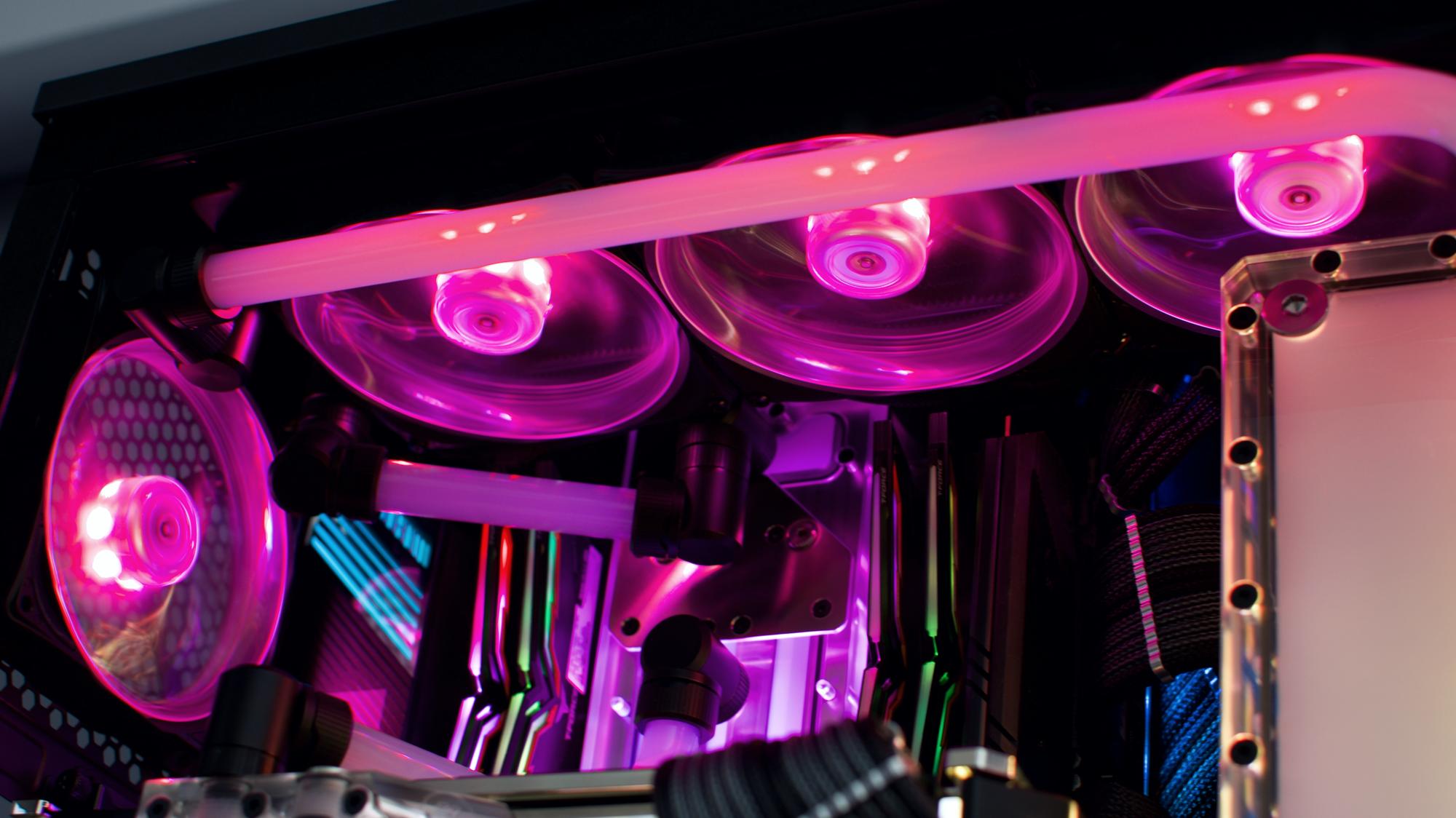
Fans are noisy because they work harder when temperatures rise.
Liquid cooling changes that game.
Air Coolers
- Large tower coolers often spin faster under load.
- You can hear the “whoosh” or whining, especially with dual-tower designs.
AIO Coolers
- Quieter than air, but the small pump adds its own hum.
- Fans still ramp aggressively during heavy loads.
Custom Loops
- With thick radiators and low-RPM fans, a high-end custom loop can stay near-silent even when the CPU and GPU are at 100%.
- You can run a render, export a 4K video, or train a model overnight and barely hear a whisper.
If silence matters — and for many creators it absolutely does — nothing beats a custom loop.
3. Aesthetics: AIOs Look Good, Customs Look Unreal
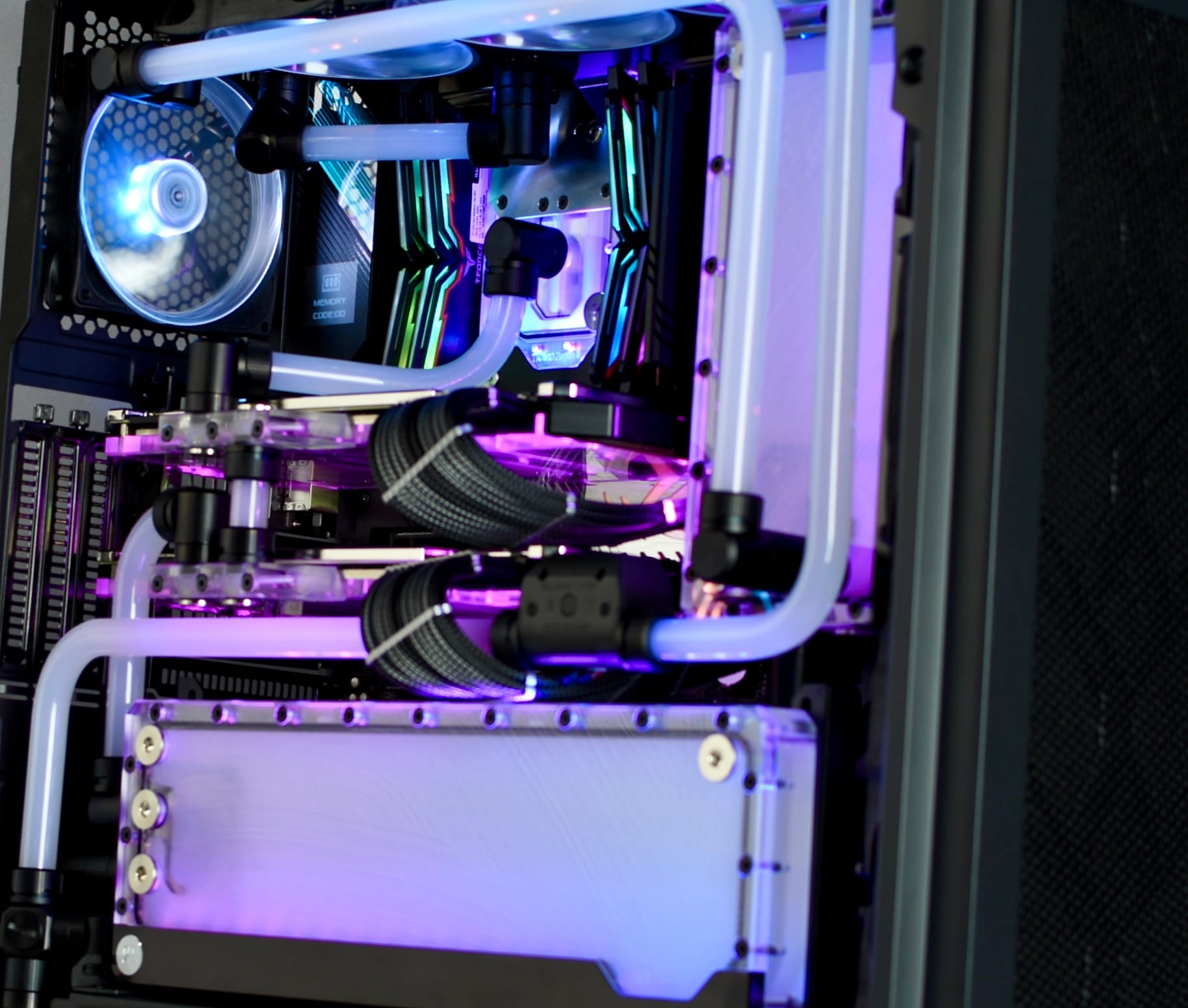
Let’s be honest: part of the reason custom water-cooling exists is because it looks insanely good.
Air Cooling
- Functional and… big.
- A giant metal block dominating your motherboard.
AIO
- Clean, minimal, backlit pump head.
- Great for gaming rigs.
Custom Loop
- Hardline tubing, crystal-clear coolant, distribution plates, GPU blocks, CPU blocks, perfect symmetry.
- Every custom PC becomes a unique piece of art.
For premium brands (like LiqquidLabs), aesthetics aren’t secondary — they’re part of the offering.
4. Maintenance: Not as Scary as People Think
One myth that refuses to die:
“Custom loops require constant maintenance.”
Nope.
Air & AIO Maintenance
- Dust cleaning every few weeks.
- AIO pumps have a limited lifespan (5–7 years typically).
- No coolant replacement, but failure == full replacement.
Custom Loop Maintenance
- Coolant top-up or change every 12 months.
- Water blocks cleaning every 24-36 months.
- Visual inspection of tubing and fittings.
- Components are modular, so nothing is “disposable.”
And if your brand offers maintanence servicing — even easier for the client.
5. Longevity: A Custom Loop Actually Extends Component Life
Modern CPUs and GPUs are built to withstand heat, but running hot consistently shortens their performance lifespan.
A cooler chip:
- draws less voltage,
- preserves boost clocks longer,
- and degrades slower over years.
Custom loops don’t just cool better today —
they help your system stay top-tier for much longer.
6. The Intangibles: Pride, Craftsmanship & Ownership
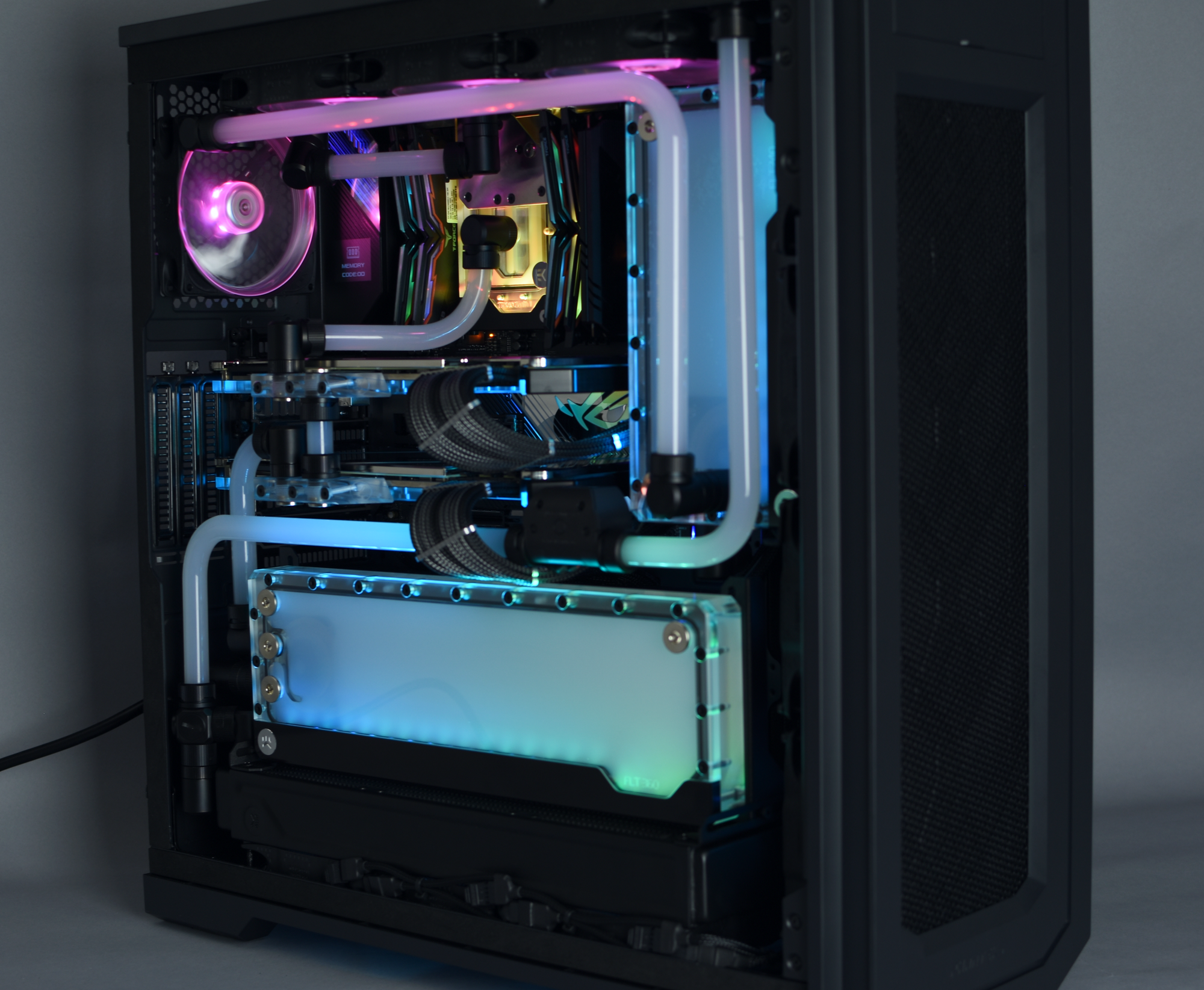
A custom-cooled PC isn’t assembled — it’s crafted.
It’s personal.
It’s a statement.
It’s something only a handful of people on Earth actually own at a high level.
Clients consistently tell us:
“It feels like driving a supercar compared to a regular car.”
And they’re right. You can feel the engineering.
Conclusion: So… Does Custom Water-Cooling Beat Air Cooling?
Absolutely — and not by a little.
For high-end systems, multi-GPU workstations, premium gaming rigs, and luxury builds, nothing compares to a properly engineered custom loop.
You get:
- the best temps
- the lowest noise
- the best longevity
- the best aesthetics
- and the most satisfying owning experience
AIOs are great for mainstream performance.
Air cooling is fine for budget or compact builds.
But custom water-cooling?
That’s where a PC stops being a machine… and becomes a masterpiece.