Why Your Gaming Rig Runs Hot: The Hidden Bottlenecks
Modern gaming PCs often run hot due to hidden thermal bottlenecks like poor airflow, overheating VRMs, misconfigured fan curves, and aging thermal paste. Learn how LiqquidLabs eliminates these issues with proper cooling engineering.

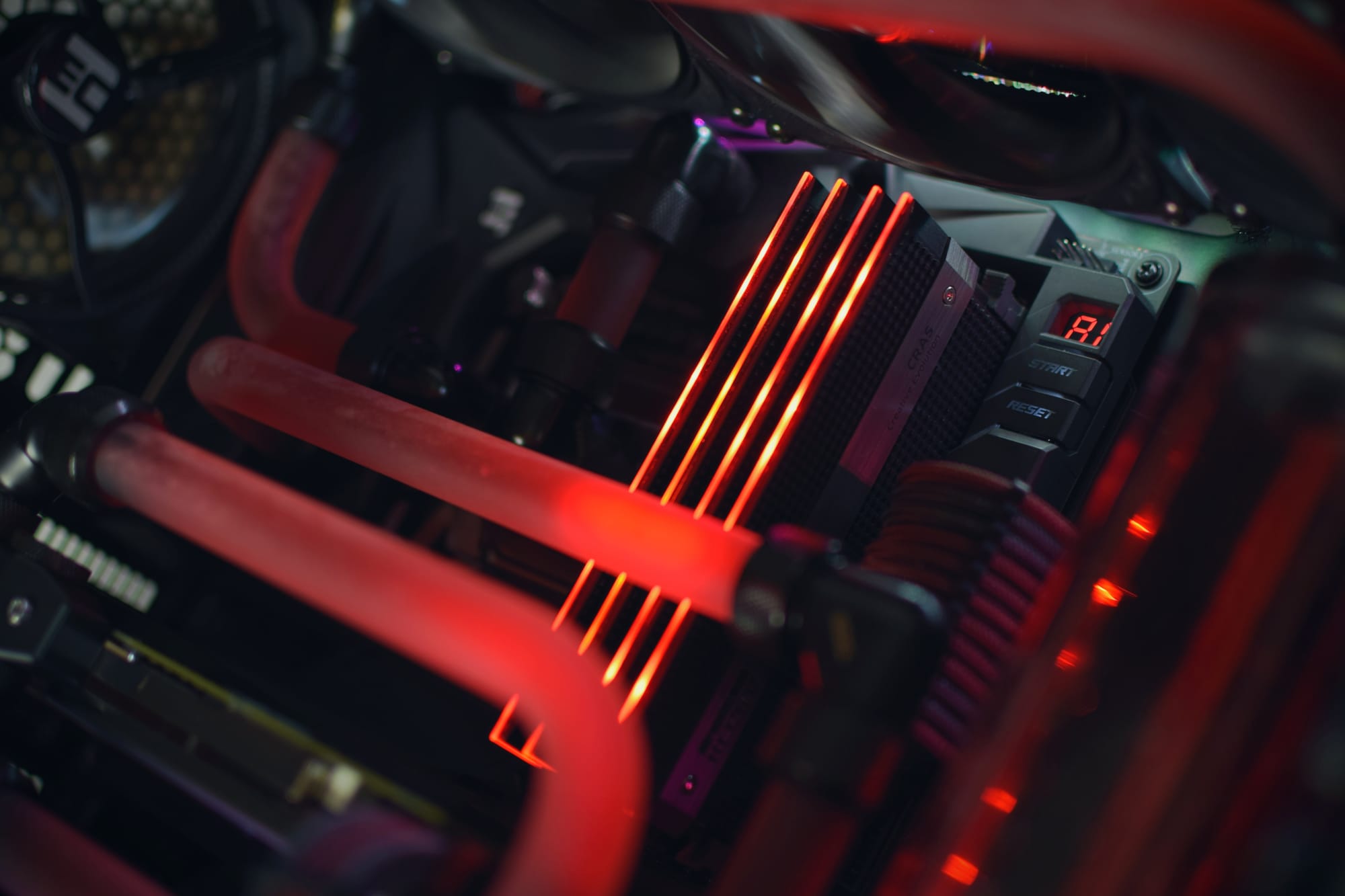
Modern gaming PCs are more powerful than ever—but also hotter, denser, and far more thermally complex. If your high-end rig runs louder or hotter than expected, even with premium components, the culprit is often not the CPU or GPU themselves, but a set of hidden thermal bottlenecks most users overlook.
Let’s break down the less-obvious contributors to excessive heat—and how properly designed custom loops and AIO solutions eliminate them.
1. Case Airflow: When “Good Looking” Isn’t Good Enough
Case manufacturers love glass. Unfortunately, airflow doesn’t.
Many modern cases prioritize aesthetics over physics:
- Restricted front intakes
- Solid glass or metal panels
- Insufficient exhaust paths
Even with high-RPM fans, airflow turbulence and pressure imbalance can trap heat inside the chassis.
The result:
- GPU heat recirculates
- VRMs cook under stagnant air
- Fans ramp aggressively to compensate
At LiqquidLabs, airflow is treated as a system—not an afterthought. Whether paired with a high-end AIO or a full custom loop, we design intake and exhaust paths to maintain laminar flow, ensuring heat exits the system efficiently instead of bouncing around inside it.
2. VRMs: The Silent Thermal Killers
VRMs (Voltage Regulation Modules) are rarely discussed outside enthusiast circles—but they matter more than ever.
High-core-count CPUs, aggressive boost algorithms, and sustained gaming or rendering loads put enormous stress on motherboard power delivery. Poor airflow over VRM heatsinks can lead to:
- Thermal throttling
- Voltage instability
- Reduced boost duration
- Long-term component degradation
In air-cooled builds, VRMs rely almost entirely on indirect airflow. Once that airflow is compromised, temperatures spike fast.
Custom loops solve this at the root.
By removing CPU heat directly from the socket area and controlling case airflow precisely, VRM temperatures drop dramatically—often by 15–25°C compared to traditional setups.

3. Fan Curves: More RPM ≠ Better Cooling
One of the most common mistakes we encounter is misconfigured fan curves.
Symptoms include:
- Fans reacting too late
- Sudden noise spikes
- High idle noise with minimal thermal benefit
Many systems rely on CPU temperature alone, ignoring:
- Coolant temperature
- GPU load
- Case ambient heat
This creates oscillation: fans ramp up aggressively, cool briefly, then ramp down—over and over.
At LiqquidLabs, fan curves are built around thermal mass, not panic responses. Custom loops and premium AIOs allow us to base fan behavior on coolant temperature, delivering:
- Smoother acoustics
- Lower sustained temperatures
- Longer component lifespan
Quiet when idle. Controlled under load. No unnecessary chaos.
4. Thermal Paste Aging: The Slow Performance Leak
Thermal paste doesn’t fail overnight—but it does fail silently.
Over time, even high-quality compounds can:
- Dry out
- Pump out under thermal cycling
- Lose contact efficiency
This leads to gradually rising temperatures that users often attribute to “normal aging” of hardware.
In reality, a CPU running 8–12°C hotter than launch day is often a paste issue—not a silicon one.
Premium AIOs with stable mounting pressure help slow this degradation. Custom loops go further by maintaining lower thermal deltas, reducing stress on the thermal interface altogether.
5. Heat Density: The Modern PC’s Real Enemy
Today’s components don’t just run hot—they run hot in very small areas.
- Chiplets
- Dense GPU dies
- Compact power stages
Air cooling struggles to move heat away quickly enough. Even standard AIOs can saturate under sustained loads.
Custom water-cooling excels here because water doesn’t just cool—it transports heat away from the source, distributing it across large radiators where it can be dissipated efficiently and quietly.
This is not about chasing record benchmarks—it’s about thermal stability.
How LiqquidLabs Eliminates Thermal Bottlenecks
At LiqquidLabs, cooling isn’t a component—it’s an engineered solution.
Our builds focus on:
- Purpose-driven airflow layouts
- VRM-aware thermal design
- Professionally tuned fan and pump curves
- Premium AIOs where simplicity matters
- Full custom loops where performance, silence, and aesthetics converge
The result is a system that:
- Runs cooler under sustained load
- Sounds quieter at all times
- Boosts longer and more consistently
- Ages better over years of use
Final Thoughts
If your gaming rig runs hot, the issue is rarely just the CPU or GPU. It’s the invisible bottlenecks—the airflow compromises, power delivery heat, fan logic, and aging thermal interfaces—that slowly erode performance.
Fixing them requires more than faster fans or bigger numbers on a spec sheet. It requires thermal engineering.
That’s where LiqquidLabs comes in.
Because true performance isn’t just measured in frames per second—but in how quietly, efficiently, and reliably your system delivers them.
Ready to drop your temps and boost performance? Get a LiqquidLabs build consultation.